
How can I get better at melodic dictation?
Five practical ways to hear, remember and write down a melody, from your first attempts to more demanding listening practice.
By MusicClassLab · Published
If you can hear a tune perfectly well but the moment someone asks you to write it down your brain decides to go on holiday, you’re not alone. Melodic dictation is one of those skills that can feel impossibly difficult until you learn to break it into smaller jobs. The good news? You do not have to catch every note on the first hearing. In fact, trying to do that is often the problem.
The big idea: don’t start by chasing every note
When I teach dictation, I encourage students to collect clues rather than attempt a heroic transcription in one go. Work out what you know first: the pulse, the shape of the tune, a note you can identify, and where the phrase ends. Each listening should answer a different question. There are no prizes for trying to do everything at once — except perhaps a slightly alarming amount of crossed-out manuscript paper.
1. Find your bearings: key, pulse and starting note
Before writing notes, establish the beat and listen for a tonal center. If the key or first note is supplied, use it: that is free information. If it is not supplied, don’t pretend you know it; listen for a convincing resting note and use the final note or cadence as a clue. Notice whether the tune begins on a strong or weak beat. Hum the opening, and mark the rhythm or contour before worrying about precise pitches.
2. Listen for the shape before the detail
Does the melody rise, fall, repeat a pitch or jump? Sketch a simple line or write arrows above the staff. Next distinguish steps from leaps. Students often get stuck because they are trying to name an interval before they have even noticed which way the tune moves. “Up a little” is useful information. “Up a little, then a bigger jump down” is even better.
Musical example 1 — Hear the shape before the notes
Before worrying about note names, follow the direction of this melody. Which notes are higher, which are lower, and where does it repeat? Try drawing its outline in the air as you listen. Yes, it looks a little like conducting a very small plane.
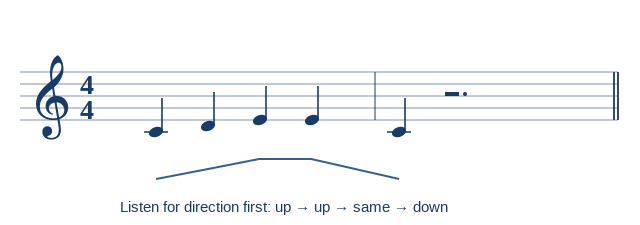
You can hear the shape of a melody before you can name every note.
Musical example 2 — Steps, leaps and repeated notes
Now look at a second melody. Circle the stepwise movement, mark the leap, and spot the repeated pitch. In class, I find that calling these three things out first often gets students much further than guessing a string of note names.
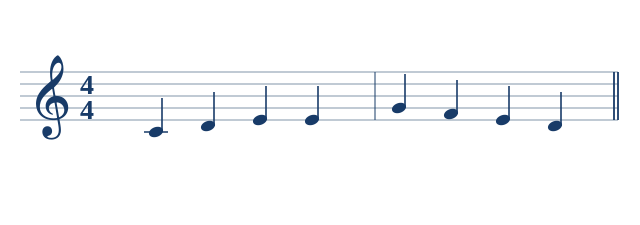
Reveal the steps, leap and repetition
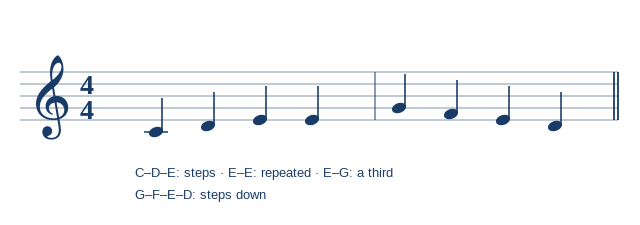
Steps, leaps and repetitions are clues, not separate mysteries.
3. Work from the front — and from the back
This is one of the most useful habits to develop. The opening is often easier to remember, so capture the first two or three notes. But don’t keep replaying the start in your head while the rest disappears. Listen carefully to the end as well: the last note, the approach to it, and any repeated or familiar closing figure. If the final note is clear, work backwards from it, identifying the preceding note and then the one before that. You can build two small islands of certainty and join them in the middle.
I often suggest treating the final two or three notes as a separate mini-dictation. It stops the classic problem of having a beautiful first measure and then absolutely nothing. A melody is allowed to have an ending, after all.
Musical example 3 — Start at both ends and work toward the middle
Listen to the phrase once for the whole shape. On the next hearing, write the first two notes. Then deliberately ignore the opening and listen for the final two. You now have two solid points to work from. On later hearings, fill the middle in one or two notes at a time. There is no prize for starting at note one and refusing to move until you have cracked note two.
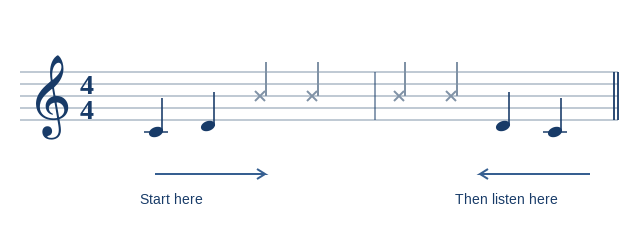
Answer — reveal after trying
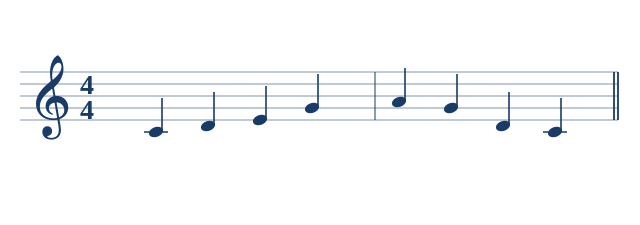
Knowing the opening and the ending gives you anchors; the middle becomes a smaller problem.
4. Use intervals and scale patterns as clues
Once you have one reliable pitch, compare neighbouring notes with it. Is the next pitch the same, a step away, or a larger leap? Sing the interval back if that helps. In tonal melodies, think about scale degrees and common patterns as well as isolated interval names. A phrase that moves 3–2–1 can be easier to hear as a little scale fragment than as two separate descending seconds. Do not force a melody into a familiar pattern if your ears disagree.
5. Check in sections, then sing the whole thing
After each hearing, check just one small section: perhaps the opening, the ending, or the leap in the middle. Sing your written version, then compare it with the recording. Does the direction match? Are repeated notes really repeated? Is the rhythm aligned with the beats? Only at the end should you try to follow the entire phrase from start to finish. If your version suddenly sounds like a different tune, that is useful feedback — not a disaster.
Musical example 4 — Build the answer in stages
Here is how I would tackle a slightly longer phrase in a lesson. First hearing: identify the pulse and general shape. Second: secure the beginning and ending. Third: listen specifically for the leaps and the notes between your anchors. Final hearing: sing your answer back and check. The aim is to make each hearing do a different job.
1. Find anchors
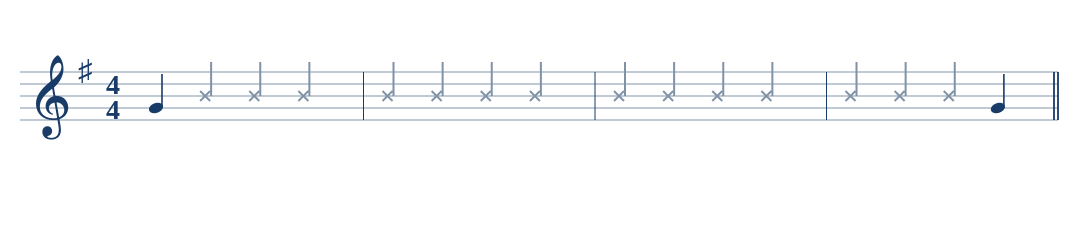
2. Add the distinctive notes
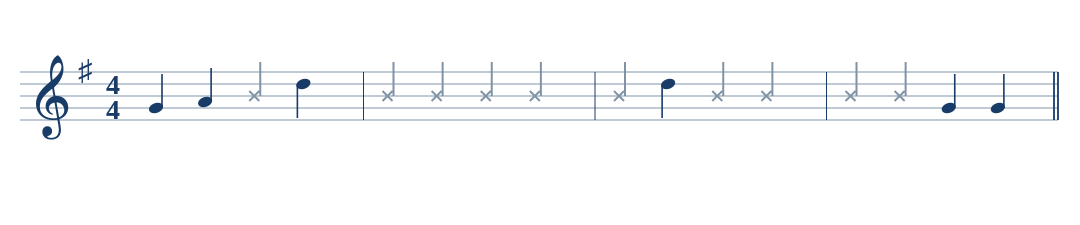
3. Check the complete phrase
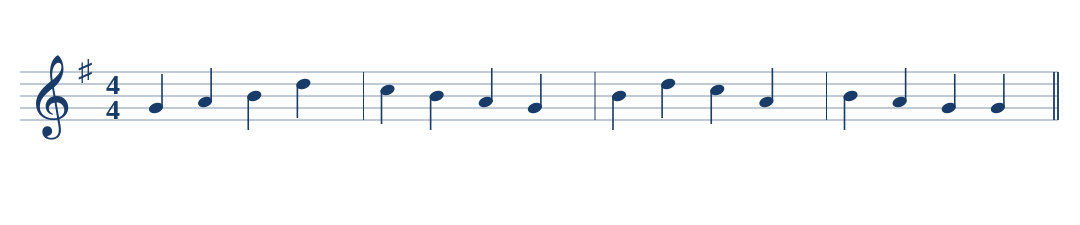
You are not meant to solve the whole melody on the first hearing.
Choose your level
Beginner: hear the outline
Start with three- to five-note melodies, a small pitch range and simple rhythms. Focus on repeated notes, steps, direction and the opening and closing pitches. Aim to draw the contour accurately before writing every note on a staff.
Developing: fill in the gaps
Move to four- to eight-note phrases, wider intervals and slightly less predictable rhythms. Write the opening and ending first, then fill in the middle. Try identifying scale patterns and checking whether each leap makes musical sense.
Exam-ready: use every hearing strategically
For exam preparation, practice longer phrases with the kind of pitch and rhythmic demands appropriate to your course. Follow the instructions and number of hearings in your actual exam specification. Use one hearing for the overview, another for the beginning and ending, and later hearings to repair uncertain notes. If a key, starting pitch, rhythm or partial notation is supplied, make full use of it. Accuracy matters more than looking busy with a pencil.
A ten-minute practice routine
- 2 minutes — Listen to short phrases and identify up, down, repeated notes, steps and leaps.
- 3 minutes — Practice intervals, singing each example before checking the answer.
- 3 minutes — Try melodic dictation: write the opening, then the ending, then work toward the middle.
- 2 minutes — Replay, sing back your answer and correct just the notes you can explain.
The key is doing a little regularly. Ten focused minutes three or four times a week beats a heroic hour the night before an assessment. Your ears do improve with practice; unfortunately, they do not respond especially well to last-minute negotiations.
Try it for yourself
You can practice for free using the Interval Trainer and Melody Dictation. Start at a level where you can succeed, then increase the challenge gradually. There are no logins or subscriptions required.
Need to refresh the building blocks? Try the guide to recognising intervals by ear, Rhythm Dictation or ear training guide.
One last classroom tip
When a student tells me, “I can’t do dictation,” I’d much rather ask, “Which bit can you hear?” Very often they can already tell me the melody goes up, where it comes to rest, or which two notes repeat. That is not nothing; it is the beginning of a transcription. Build from the notes you know, listen backwards as well as forwards, and give yourself permission to solve the melody in pieces. Even the best ears don’t need to do it all in one go.