How to Read Key Signatures Without Counting Everything
A friendly guide to sharp and flat key signatures, relative minor keys and finding where the music feels at home. Three levels, clear diagrams and 15 interactive questions.
By MusicClassLab · Published
Key signatures are one of those things in music that look rather more complicated than they actually are. You open a piece of music, discover five sharps sitting at the beginning, and suddenly wonder whether you should have taken up the drums instead.
Fortunately, there are a couple of tricks that make the whole business much easier.
Level 1 · How to read sharp and flat key signatures
A key signature is the group of sharps or flats at the beginning of each staff. It tells you which notes are normally sharp or flat throughout the music, unless an accidental tells you otherwise.
Sharp keys: find the last sharp, then go up a half step to find the major key. If the last sharp is F♯, the key is G major. If it's C♯, the key is D major. If it's G♯, the key is A major.
Flat keys: the second-to-last flat gives you the major key. B♭, E♭ and A♭? The second-to-last flat is E♭, so the key is E♭ major.
Two useful exceptions: C major has no sharps or flats, and F major has just B♭. The second-to-last-flat trick cannot work when there is only one flat!
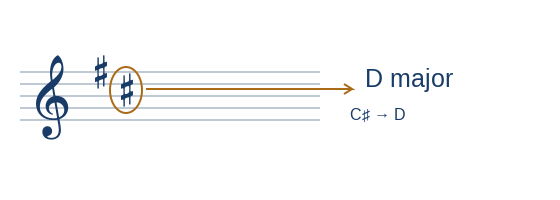
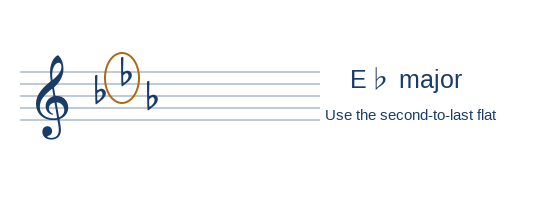
Have a go: identify the major keys with one sharp, four sharps and four flats. Answers: G major, E major and A♭ major.
Level 1 check · five questions
Answer one question at a time and see why each answer works.
Level 2 · Find major keys and relative minors
First, remember that sharps and flats arrive in a fixed order. Sharps: F, C, G, D, A, E, B. Flats go in the reverse order: B, E, A, D, G, C, F.
The sharp-key shortcut is actually a half step above the last sharp, not just the next letter name. That distinction matters: the last sharp in B major is A♯, and a half step above A♯ is B.
Once you've found the major key, you can find its relative minor by going down three half steps from the major tonic. G major shares its key signature with E minor; E♭ major shares its signature with C minor. Same collection of key-signature notes, different tonal center.
There is a catch, though. A key signature doesn't prove which key the music is actually in. A piece with one sharp might be in G major or E minor, and it could even move somewhere else during the piece. To decide, look and listen for the note and chord that feel like home.
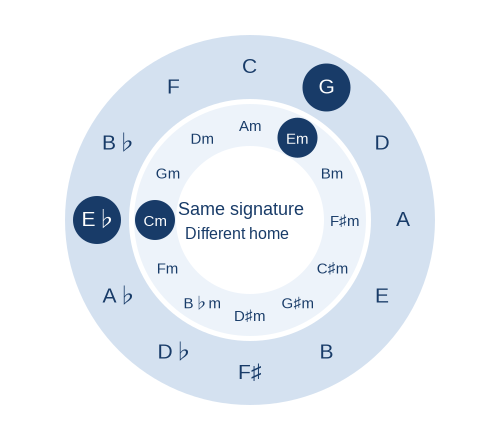
Quick check: five sharps? The last is A♯, so B major or G♯ minor. Two flats? B♭ major or G minor.
Level 2 check · five questions
Answer one question at a time and see why each answer works.
Level 3 · Use cadences and accidentals to identify the key
As your music theory develops, recognising the written signature is only the beginning. The more interesting question is how the music uses its notes to establish a key.
Take a piece with no sharps or flats. C major is the obvious possibility, but A minor uses the same key signature. In A minor, you might hear or see G♯ as a leading note rising toward A, particularly in an E major or E7 chord resolving to A minor. That G♯ is an accidental; it doesn't need to appear in the key signature.
Similarly, the signature doesn't tell you whether the music is currently centred on its relative major or minor, nor does it guarantee the piece stays there. Composers can briefly establish another chord as a local tonic, move more decisively to a new key, or write passages that deliberately avoid a clear tonal center.
A good approach is to combine three clues: the key signature, the harmonic movement, and the sense of arrival. Look for cadences and dominant-to-tonic relationships, listen for where phrases settle, and pay attention to accidentals that might suggest a new leading note.
For example, in a passage whose signature has one sharp, a D7–G cadence supports G major. An E7–Am cadence points instead toward A minor, despite the same original signature. Context wins.
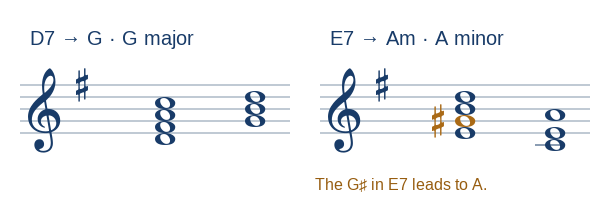
When explaining a key, don't write 'the piece is in G major because it has one sharp' and stop there. Say that the one-sharp signature is consistent with G major, then support your answer with a cadence, tonic chord, or another musical clue.
Level 3 check · five questions
Use what you know about harmony. Playable examples appear after selected answers.
The 30-second version
For a major key with sharps, go up a half step from the last sharp. For a major key with flats, name the second-to-last flat. Remember the exceptions: C major has none; F major has one flat. For the relative minor, go down three half steps from the major tonic. And when you're analyzing real music, use the harmony and what you hear · not just the signature · to decide where home is.
Keep practicing key signatures
Head to MusicClassLab's Key Signature Challenge and see how quickly you can recognize the keys. Start slowly. Accuracy first; speed can come later.
Practice identifying major and minor keys in Key Signature Challenge. Explore the relationships in the Interactive Circle of Fifths, then build scales using the right notes.
For the listening clues in Level 3, try Cadence Trainer and Modulation Trainer.
Notation uses original MusicClassLab examples and Bravura music glyphs, © Steinberg Media Technologies GmbH, under the SIL Open Font License.